


“The future will reward clarity, but punish certainty.”
I share this quote from Bob Johansen more than any other in my futures work.
Bob is one of the most prolific and influential futurists in the world. As the former head of the Institute for the Future, a 50+ year futures think tank based in Palo Alto, Bob has authored over 15 books helping leaders and organizations retool their thinking and processes to be more future-forward. His books Leaders Make the Future and Get There Early are two of my favorites - they are classics on how to infuse and integrate futures approaches into any organization or strategic planning process.
His profound quote reminds us that with so much uncertainty swirling, we don’t need to know all of the answers. In a world moving so fast, we simply can’t have “certainty.” But we can have clarity about the values, big ideas, and ideals we’d like to see in the future.
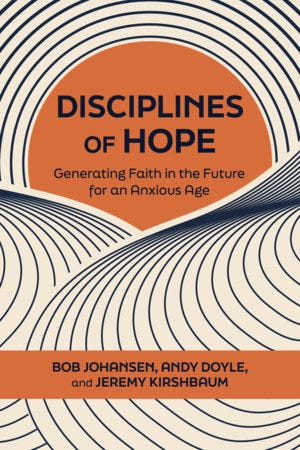
When Bob reached out about his latest book Disciplines of Hope: Generating Faith in the Future in an Anxious Age—co-authored with Bishop Andy Doyle and Jeremy Kirshbaum (an AI engineer and poet, which should tell you something about the book’s ambition)—I was so excited to welcome him and Bishop Andy on How We Future.
As they share, Disciplines of Hope is not a religious book, but it takes religion seriously. It’s not a technology book, but it reckons honestly with generative AI as a force reshaping meaning. And it’s not a self-help manual, but it offers concrete practices for living with more faith and less certainty.
Here are a few of my favorite moments from my conversation with Bob and Andy:
Navigating a BANI World
Bob frames our moment using a new acronym called BANI, describing a world that’s Brittle, Anxious, Nonlinear, and Incomprehensible. Bob shares that his earlier description of VUCA (volatile, uncertain, complex and ambiguous) just wasn’t “VUCA enough” for this moment.
One of Bob’s many gifts is to look for adaptive ways to respond to the moment we’re in, offering a positive alternative: bendability instead of brittleness, attentiveness instead of anxiety spiraling, neuroplasticity instead of linear rigidity, and interconnection instead of isolated overwhelm.
Throughout our conversation, Bob, Bishop Andy and I discussed how learning these practices becomes foundational for leaders navigating organizational change, for educators preparing the next generation, and for all of us trying to be good ancestors.
As they say in the book, “when certainty fails something needs to take its place….what replaces certainty is disciplined practice.”
Faith as a Verb
In full disclosure, this is the first conversation I’ve ever had with a Bishop. And, I was kind of nervous talking about concepts around faith.
But Bishop Andy quickly made me feel at ease about this. He described faith not as something you have or don’t have, but as a practice. Something you do repeatedly, together, in community.
As they say in the book, “Faith is lived as practiced trust: it creates belonging, sustains repair across a lifetime, and is carried in habits and communities—not in propositions alone.”
I started How We Future to model what it looks like to be agentic in a world that feels out of control. And faith, or hope, in a positive future is a huge part of that.
Keep the Gifts. Refuse the Harm.
Throughout conversation, Bob and Bishop Andy talked about widening the intentional choices we can make to create more hopeful conditions and pathways for the future.
That faith in the future requires “managing ongoing tensions” with clarity versus solving complex problems with certainty.
Fueling their ongoing clarity is the idea of “keep the gifts” and “refuse the harm.” This is true for religious practices, but also in how we think about all kinds of decisions, including how we build technology, how we treat our neighbors, how we build culture and community, among others.
“Our ‘keep the gifts, refuse the harm’ mindset sounds like this: keep practices that form courage, honesty, and neighbor-love; refuse the impulse to treat righteousness as an inside team sport.”
Exploring the Credible Hope Compass
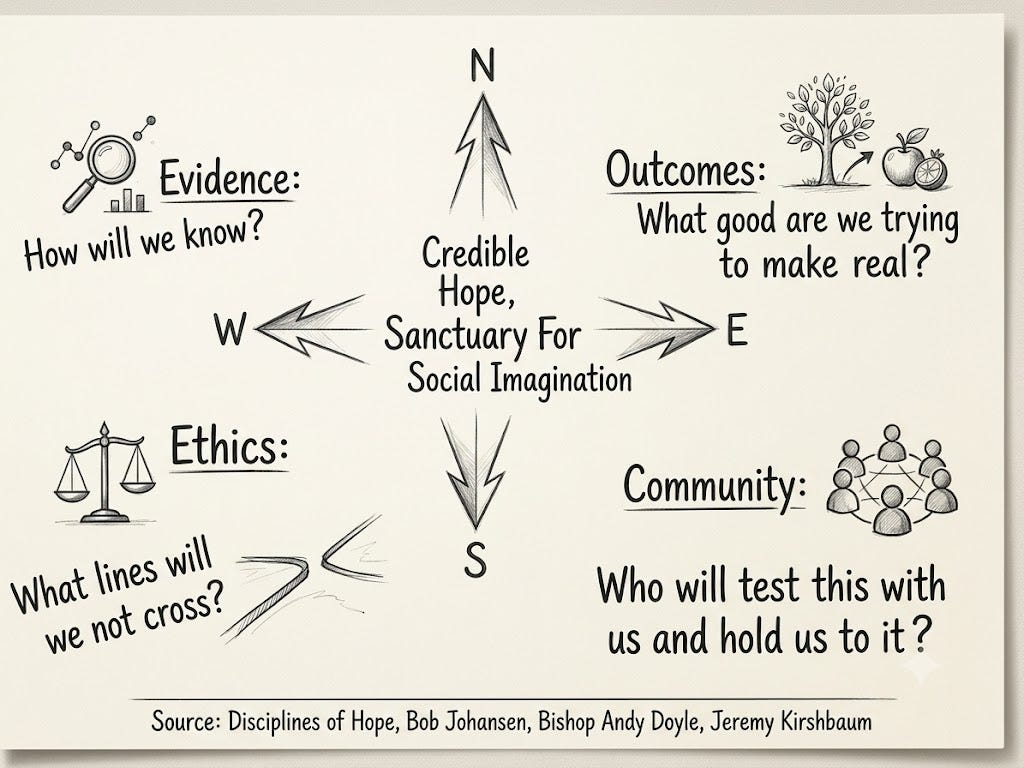
Disciplines of Hope provides guidance on how to implement these ideas into action through a tool called the Credible Hope Compass, described beautifully as a “sanctuary for social imagination.”
It’s a navigation device with four directions: outcome (clarity about direction), community (who are we doing this with?), ethics (what boundaries hold us together?), and evidence (how do we know we’re getting closer?).
It makes room for what Bob calls “discerning”—the ongoing practice of asking better questions, leaning in longer before jumping to certainty, and being willing to adjust course based on what you learn.
Trustworthiness as a Pathway to Hope
I love how this book ends: “Do not try to feel hopeful; try to practice trustworthiness. Do not try to win; try to repair. Do not seek frictionless certainty; seek practices that cost you something.”
Disciplines of Hope releases this fall. Pre-order it here and find links to the full How We Future episode below.
Listen to the episode on:
Find out more about the episode and read along:

Follow How We Future:
Want to contact us? Email hello@howwefuture.com
Thanks Lisa! Always love to read anything on hope, as "lifeing" is tied intimately to hope as the ongoing movement of awe, wonder, and enchantment (as opposed to simply being an internal feeling that carries us through times of crisis and despair).
May I add a twist? There is no such thing as a VUCA, BANI, or TUNA world (ie various iterations of volatile, uncertain, brittle, ambiguous, turbulent, anxious, incomprehensible, etc.) There is only a VUCA, BANI, or TUNA position and perspective that is fashioned by our system of colonized separation (or as Nora Bateson says, "We've forgotten how to be in life"). The world - not our present dominant narrative and construct that is held only by dissociated humanity, but rather the totality of life’s symbiotic movement that includes humans, kin, planet, cosmos - is ALIVE and beckons us to join in being ALIVE that is already in progress (ABDUCTIVE processes of entanglement that generates mutual learning and novelty across contexts, LIMINAL spaces of interaction where shifting contexts generate emergence and flourishing, INTERCONNECTED/INTERDEPENDENT relationality that is the essence of all life, VIBRATIONAL frequencies of consciousness through which life manifests the cosmos’ irreducible driver of evolutionary and imaginal love, and EMERGENT realities of complex potentiality). ALIVE is where agency resides - relational, enactive, embodied, collective and cooperative with all of life - and this is the wellspring of hope beyond our manufactured metacrisis of heart and soul.
Our position and perspective creates our reality, whether that reality aligns with life’s movement or not. Our present reality is illusory, and ongoing crisis is one of its features that keeps the hamster wheel spinning. But it’s a hell of a drug, and sells like hotcakes!