

How to Have a Better Day (Even When Things Feel Overwhelming)
A conversation with Caroline Webb

We’re getting close to Thanksgiving and the holiday season, where our schedules and commitments (and sometimes our emotions) can start to feel a little stretched in all directions.
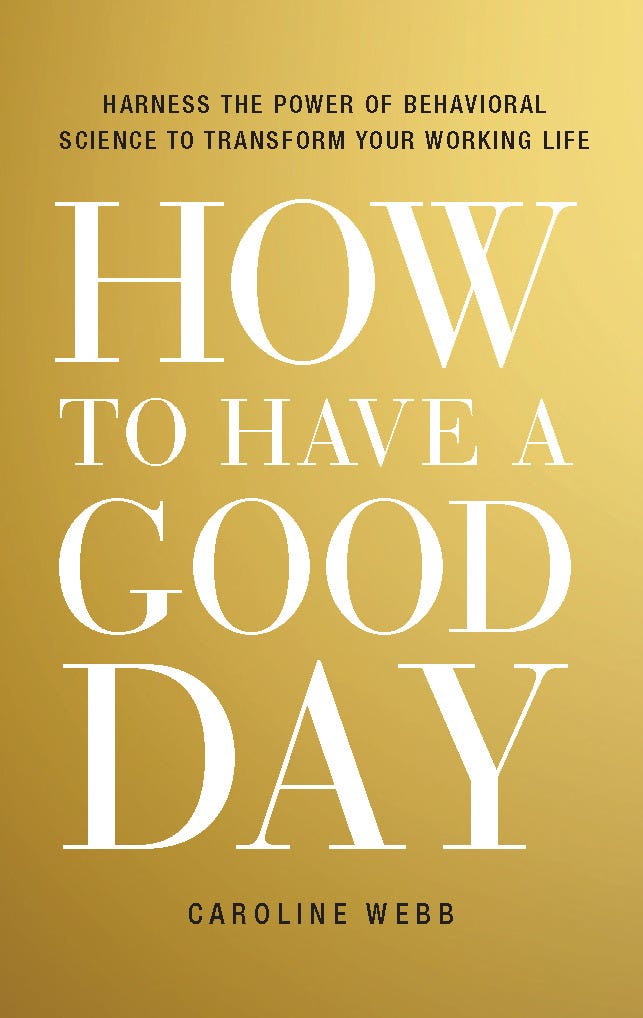
It feels extra fitting, then, that my next podcast conversation is with the wonderful Caroline Webb, author of the bestseller How to Have a Good Day. An economist by training, former McKinsey partner, and longtime leadership coach, Caroline is no stranger to busy and stressful days. She has spent years researching and integrating science-backed methods and approaches to making our days more reflective, connected, joyful, and purpose-driven.
Caroline’s insights are practical, grounded, and approachable. Her work is both universal (who doesn’t want to have a good day?) and particular (focused on concrete behaviors around specific moments). She’s not asking you to completely overhaul your life or create elaborate systems you’ll abandon by next Tuesday.
With the holidays coming up - which, let’s face it, can bring stressful moments - Caroline makes an important distinction between general stress and negative stress. Negative stress includes situations that are demanding, unpredictable, AND negative. Knowing this distinction can inform how you respond.
When you understand this, you can practice more productive intervention strategies:
For the negative: Can you find meaning in the negativity? Can you find what you care about in the situation? Can you connect it to values?
For the unpredictable: Focus on what IS manageable and what you DO know.
For the demanding: Remember that physical self-care (sleep, breathing, movement) signals to your brain that “I’ve got this.”
This is why meditation and sleep matter: not as luxury self-care, but as fundamental ways your brain assesses whether you can handle what’s in front of you.
Three Big Ideas for Having Better Days
1. Focus on Realistic Optimism
Caroline introduced me to a phrase that has stuck with me: realistic optimism. (Fun fact: she wrote about this as her life philosophy in a school yearbook at age 17!)
This isn’t toxic positivity. It’s not pretending everything is fine when it’s clearly not. As Caroline explains, when a leader only does the optimism part without acknowledging the challenges, people feel gaslit. But when you say “Yes, this is difficult AND here’s where we can take steps to move forward” - that’s when real leadership happens.
The science backs this up: affect labeling (naming the emotion you’re feeling) actually reduces the grip that emotion has on you. So when things get sticky in a meeting, sometimes the most powerful thing you can do is simply say: “This feels hard, doesn’t it? Let’s take a moment.”
2. Harness Attention Intentionally
Our attention is the currency of our lives, and we have much less of it than we think. Being intentional about where we direct it, especially amid chaos, is essential.
When everything feels uncertain, we often freeze or panic. But Caroline offers a brilliant reframe through what she calls “Know, Be, Do”:
What do we KNOW for sure? There’s often more here than we think - maybe we don’t know the outcome, but we know the process or the timeline
Who are we BEING? What are our values? What do we want to be known for? What has been true about us that will still be true?
What can we DO? Where do we actually have agency?
As Caroline put it: “The clarity of where attention should be going is such a gift when you’re in a team that’s being led by a person who knows how to do that.”
3. Rehearse the Future Before It Arrives
I have long advocated that it is better to rehearse the future than be blindsided by the present. Rehearsal of potential futures, good or bad, allows you the space and time to think through preferred responses as opposed to reactive ones.
Caroline shared some fascinating neuroscience research that suggests when you mentally rehearse a situation and how you’ll respond to potential roadblocks, you’re creating some of the same neural activity as when you actually encounter that situation.
Caroline calls these “implementation intentions” but uses the simpler framework of “When/Then”:
When this person interrupts me, then I will take a breath, smile, and remind myself that this is a frail human with quirks, just like me.
This isn’t about predicting everything that will happen. It’s about not being blindsided, either by the possible responses or by your emotions.
Caroline suggests that we can all start by building self-awareness around our stress “tells” (sweaty palms, racing heart, that phrase that runs through your mind) and our “cues” (specific situations that push our buttons).
Once you know your early internal signals around stress or uncertainty, you become more equipped and practiced at handling those moments productively and thoughtfully.
Before we wrapped up, Caroline shared a phrase from conductor Ben Zander that she now uses with all her coaching clients. When his musicians made a mistake, he taught them to throw their hands in the air and say: “How fascinating! What can I learn from this?”
This shift in mindset reminded me of an earlier How We Future conversation with improv educator Dan Klein. Dan talked about mistakes as an opportunity to say “Oh Good.” Reframing mistakes as new opportunities to learn is a resilient and adaptive leadership practice we can all try.
What a gift that simple reframe is, especially as we head into a busy season.
As we move into the holidays with all their demands and delights, I’m holding onto Caroline’s wisdom: Focus on what you can control. Name what’s hard. Find what’s meaningful. And remember: you have more agency than you think.
Here’s to having better days, together.
Listen to the episode on:
Learn more about Caroline’s work at https://carolinewebb.co/
(that’s .co, not .com!)
Caroline’s next book, LEADERSHIP INTELLIGENCE: Science-based strategies for mastering 21 everyday management challenges will be out early September 2026. Stay tuned!
