

Collective Futuring
Creating Tomorrows Together through Context, Content, and Craft

We’re living through a moment that demands we imagine together. Climate, AI, democracy, equity—the challenges we face aren’t just complex, they’re interconnected. And they require a different kind of discovering and building together—not through meetings and conferences that feel performative, but creative conversations and convenings where people feel brave enough to imagine genuinely new futures with - and for - each other.
A couple of weeks ago, I watched this in action at Siegel Family Endowment’s #TechTogether convening on the future of “Public Interest Technology” hosted at Cornell Tech’s campus during the UN General Assembly week in New York. It was an extraordinary gathering of 150+ funders and innovators focused on how technology can serve democracy, equity, and the common good. I participated alongside colleagues from the Stanford d.school as part of a new joint effort to explore how we might use emerging technology for social good at scale. The theme was exploring “Improbably Good Futures,” a title so inviting, it makes me smile just reading it.
Getting that many people to give you permission to imagine and build—especially in these times— feels both urgent and hard. I know others are feeling this need too. Recently, Rockefeller Foundation’s Chief Innovation Officer Zia Khan posted a provocative article on LinkedIn: “Panels Don’t Solve Problems, Strategic Convenings Do.” It clearly struck a nerve, generating nearly 1,400 responses and over 150 comments. Julia Roig, Founder and Chief Network Weaver at The Horizons Project, reposted Khan’s article with an open wonderment, “One of my biggest bugaboos is WHY WE KEEP CONFERENCING the same way?!?!?.” Her post got over 600 responses and 125 comments.
These animated responses are the future asking us to do better.
And we can.
I’ve been exploring how to design strategic conversations and collaborative convenings for years—work captured in my book Moments of Impact: How to Design Strategic Conversations that Accelerate Change and more recently in The Futures Happening Playbook on Civic Imagination. I believe that learning how to design these gatherings is one of the important leadership skills of our time.
One critical element of an ambitious futuring session like this is the choice of host and moderator—or, as I like to call it, the Futures Facilitator. The Siegel team could not have picked a better choice than my friend and colleague Aisha Bain. A storyteller, strategist, and “time traveler,” Aisha and I first connected virtually during the pandemic, when I hosted her and fellow futurist Meredith Hutchison to talk about their shared creative passion to use the past to unleash new futures in the d.school’s Futures Series. Since then, we’ve collaborated on projects at SXSW, convenings for educators, ambitious civic futures and more.
Watching Aisha host the Tech Together convening was a masterclass in futures facilitation. And a model for how to make convenings, conversations, and gatherings more generative, joyful, and impactful.
For Aisha, “futuring” is not escaping reality, but transforming it together.
What gives me hope is that these skills—essential for any leader or organization wanting to bring people together to solve complex challenges—are teachable and learnable.
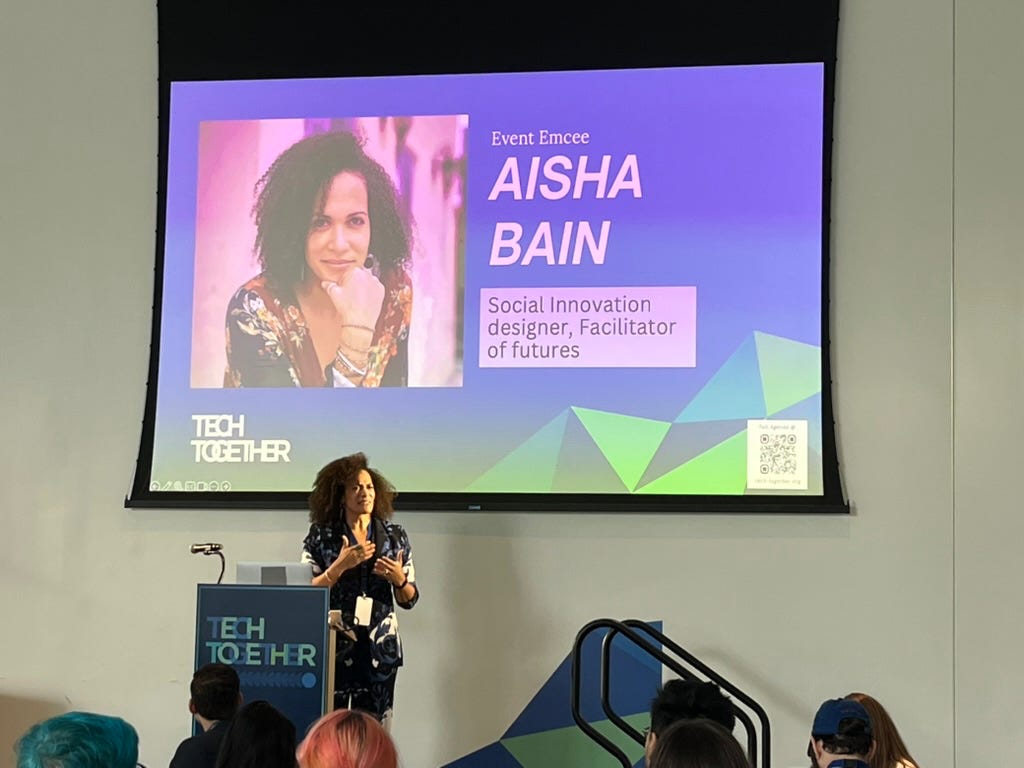
Context: Setting the Strategic Altitude
The first moments of any futures convening are critical. Context is about setting the purpose intentionally—balancing stretch and relevance in a way that orients people to both “why” and “why now.” This requires systems thinking: the ability to position the experience and conversation at a strategic altitude that resonates.
Aisha framed the work of futuring itself with wisdom that immediately shifted the room’s energy. She challenged us to see: “Imagination as Infrastructure: Imagination empowers movement. We have to be ready to build what we haven’t seen.”
She didn’t stop there. She acknowledged the very real fears in the room—job displacement, algorithmic bias, democratic erosion—while insisting we not get trapped in someone else’s imagination of what’s possible. As she put it: “We live in impossibility all around us. So who determines what is possible?”
This is what context at the right altitude looks like. It’s not just intellectual framing—it’s about using metaphors, phrases, and images that capture people’s hearts and energy, not just their heads. Aisha used language that was both poetic and political: “We are the bridge between memory and possibility, and we are the bridge between what has been and what must be.”
She understood that everyone in that room already had the superpower of prospection—the ability to imagine multiple futures. Most of us only use it when we’re lying awake anxious about everything that could go wrong. Her job was helping people recognize and intentionally redirect this capability toward transformation rather than worry.
Aisha’s message was both urgent and empowering: “Traveling into the future is not about escaping reality—it’s about transforming it together.”
Perhaps most importantly, Aisha reminded the room that “futures are plural—not one future.” We can share direction like a compass while acknowledging multiple pathways forward. This isn’t relativism; it’s strategic wisdom. As she noted: “More than one thing can be true at the same time.”
Content: Grounded in Integrity and Depth
Context without substance is just inspiration theater. The content of futures work must be grounded in integrity, depth, and concreteness—otherwise you’re just waving hands at possibility.
Aisha didn’t just talk about imagination as serious work—she demonstrated it.
As she put it: “Visioning requires imagination—it’s not a soft skill. Anyone that tells you that it is, wants to keep you in your place.”
To help set a strong foundation of content for the gathering, Aisha interviewed Volker Türk, the UN High Commissioner of Human Rights, in a riveting conversation that explored a foundational idea: digital rights are human rights. The video of their full conversation will be available soon, but I wanted to highlight the masterful questioning that established the depth of this transformational moment.
Interviewing anyone around a complex topic is difficult. Interviewing a public figure like the UN High Commissioner of Human Rights on the future of digital rights as an extension of human protection and flourishing? That requires next level preparation and skill.
In just 30 minutes, Aisha moved the arc of inquiry from establishing a baseline of understanding (What do you wish people understood about human rights in a digital era and moment of transformation?) to action (How can we use power to strengthen opportunities? What will enable systems change?) to hope (What do you want this group to say to the future about what we did in this pivotal time? What gives you hope?).
Each question built on the last, creating a bridge between present challenges and future possibilities. Aisha didn’t shy away from difficult questions, but she created space for generative and expansive reflections that invited the group to build on what they heard. This is content with substance—questions that surface new thinking and prompt new questions, rather than confirm existing beliefs.
Craft: The Details That Bring It All Together
Context and content won’t land if the craft isn’t there. Craft is about paying attention to every detail that creates the conditions for transformation.
Can you stitch together planned and emergent content? Can you hold space without commandeering it? Can you inspire authentic connection? This requires knowing your own strengths and staying attuned to every detail—your presence, your energy, what you’re wearing (it matters), what music is playing as people enter the room.
What I witnessed in Aisha’s facilitation was someone who understood that craft means conducting high-stakes interviews and panels to surface new perspectives, building psychological safety with strangers, delivering content and context while managing timing and logistics—all with equal grace and gravitas.
It’s the ability to frame the conversation with intent and purpose, communicate authentically and connectedly, and move a room of 150+ people through a journey that honors both what has been and what could be. This level of craft doesn’t happen by accident. It comes from deep preparation, self-awareness, and attention to the full experience.
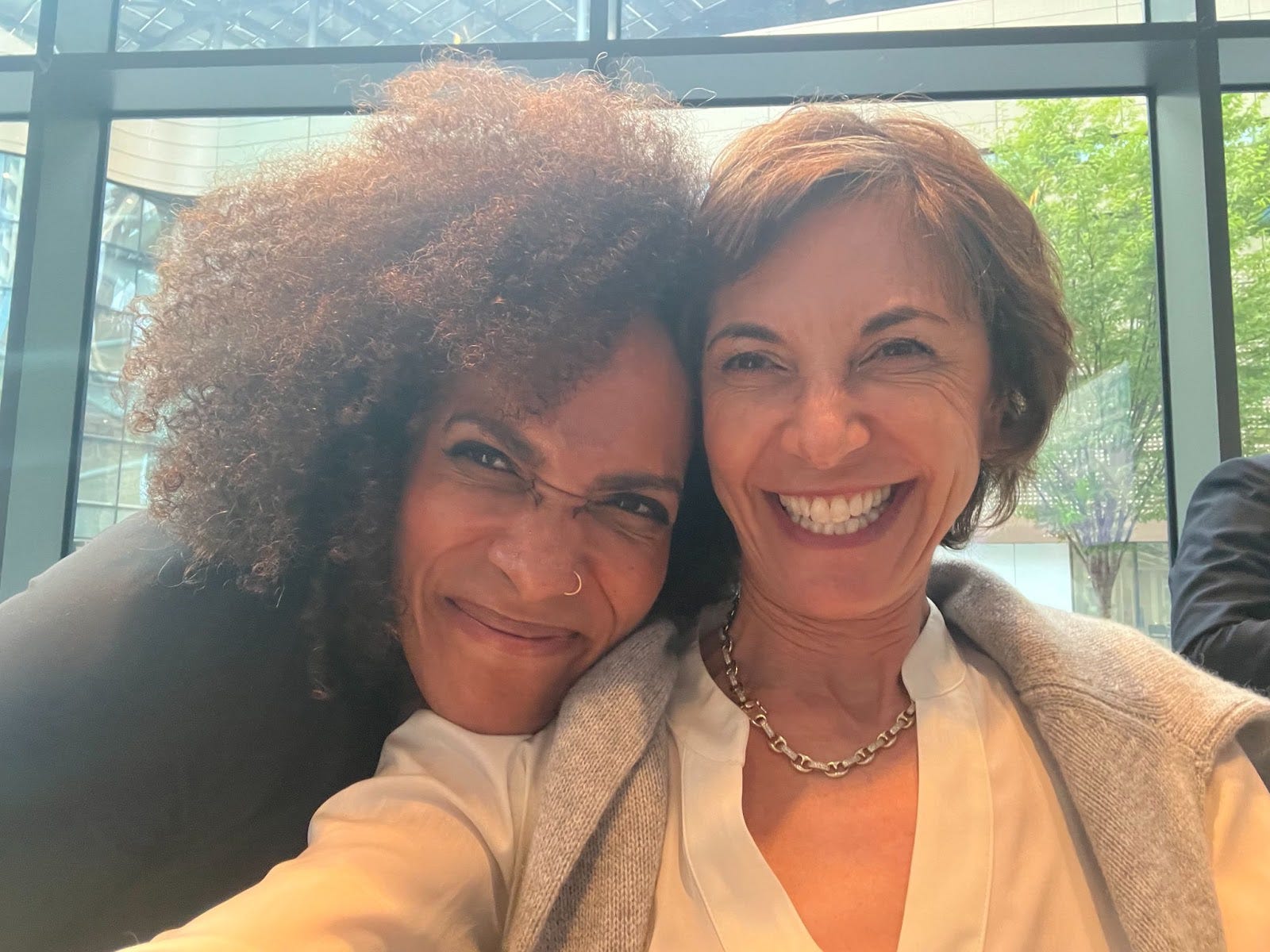
The question isn’t whether we’ll shape the future—it’s whether we’ll do it with the intention, wisdom, and masterful facilitation that the work requires.
In the coming weeks, I’ll be posting more insights and conversations about futures facilitation, including a fantastic podcast conversation with another treasured colleague, Jeff Rogers. And I’d love to hear from you—what does futures facilitation look like in your world? Your thoughts and stories might just spark the next post in this series.
This really got me thinking about how futuring reframes imagination - not as escape or speculation, but as design for continuity and care. I keep coming back to the idea that transitions are the frontlines of the future, where the next version of an organization, community, or self begins to take shape. Healthy transitions honor the past, inclusive ones widen the circle of belonging, and effective ones build the structures and stories that sustain what’s next. In that sense, every transition is a futuring exercise: a rehearsal for a world that doesn’t yet exist.
Thanks for this Lisa! Over this Sunday morning's coffee I would say that in my world, the kinds of futures facilitation that feels engaging, accessible and, well..'fun' looks quite a bit like material speculation. What I mean by that is creating artifacts from possible worlds that provoke conversation, not necessarily consensus. Creating dialogue in a hands-on and somewhat kinetic fashion. I look at futures work as not about predicting or even persuading, but designing invitations to notice what kinds of futures we seem to be most implicitly constructing. (The other way around that is wondering out loud and consider that it is a question to wonder 'who's future am I living in?') The kind of futures facilitation I see is all about exploring a kind of 'field of fragments' — the things you might find if you imagined yourself trying to understand a world only from the artifacts it left behind. Less frameworks and more objects that ask questions rather than answer them. Facilitation then becomes a project of curation, where participants in the room don't just imagine, they interact with the worlds they would prefer to inhabit (or the worlds they are questioning) as if they are already within it.