

Drawing Our Way to Better Futures
Lessons from Visual Thinking Pioneer Dan Roam

When I was a little kid, I loved to draw. I remember filling pages with horses, dancers, and new cartoon characters.
And then I stopped. Maybe I ran out of time, or maybe, like so many of us, someone told me I wasn’t “good” at it. Certainly, no one told me that scribbling on a page would help me become a better thinker, problem solver, and communicator.
That is, until I met Dan Roam.
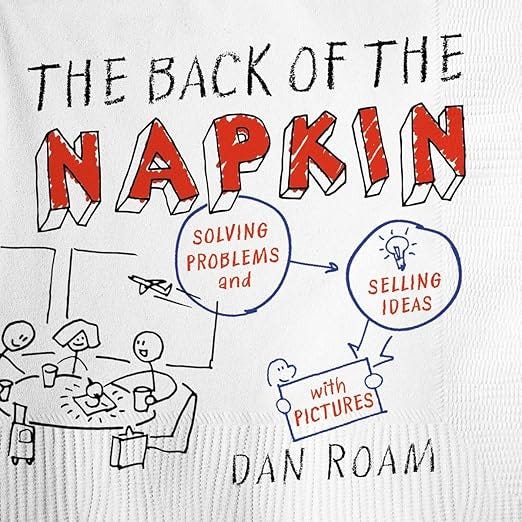
Dan is the author of six international bestsellers, including the groundbreaking The Back of the Napkin: Solving Problems and Selling Ideas with Pictures and Blah, Blah, Blah: What To Do When Words Don’t Work.
Dan helped me see that visual thinking is not about drawing - it’s about leveraging our innate human processing power of our “eyes and mind’s eye to Look (gather info), See (find patterns), Imagine (manipulate ideas), and Show (communicate clearly) using simple drawings to solve problems.”
In other words, as Dan says, “Visual thinking is the future of problem solving.”
In our latest How We Future conversation, Dan and I explored how our brains make sense of what we see and how this process can help us navigate even our thorniest issues.
Here are three insights from our conversation that may change the way you think about your own drawing ability and how to approach your next challenge using visual thinking.
1. We are All Visual Thinking Machines
Somewhere between 30-50% of our brains are dedicated to visual processing, much more than any other sense. According to Dan, “We are all walking, talking visual thinking machines.”
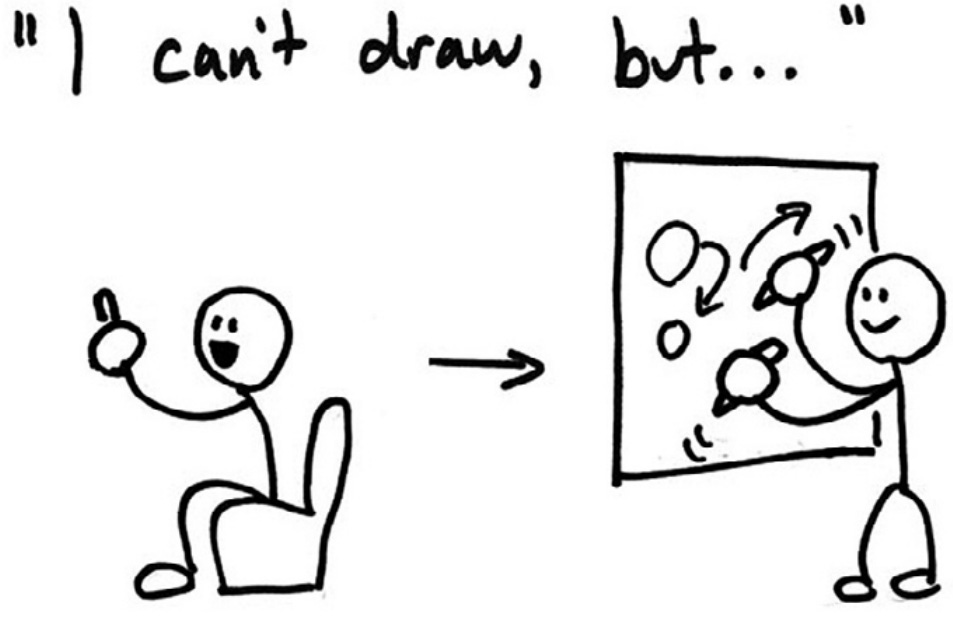
Yet, around second grade, most of us were told to put away the picture books and focus on words. We essentially abandoned our most powerful thinking tool right when we were getting good at it. As I’ve often heard Dan say, “everyone starts off saying, I can’t draw, but…”
Over the years, Dan and I have worked with educators, teaching them how to weave visual thinking into the classroom. We’ve seen firsthand how “drawing the answer” can unlock a student’s potential in a way that a multiple choice test never could.
One of my favorite memories is visiting my daughter’s elementary school with visual practitioners Lynn Carruthers and Emily Shepard. We helped the teachers explore how to bring visual thinking into their classroom experiences, and to look for more opportunities to draw out concepts and see “doodling” as a vehicle for better thinking, not as a distraction!
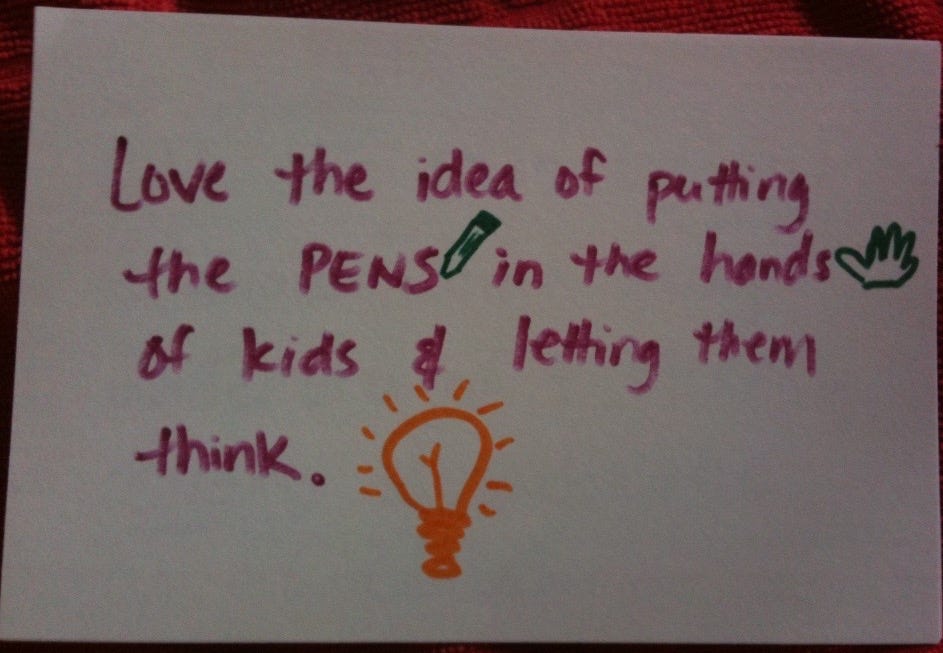
Not only did the teachers love it (we got amazing visualized feedback cards!), but the school principal decided to turn their mission statement and values into a powerful visual that hung in every classroom.
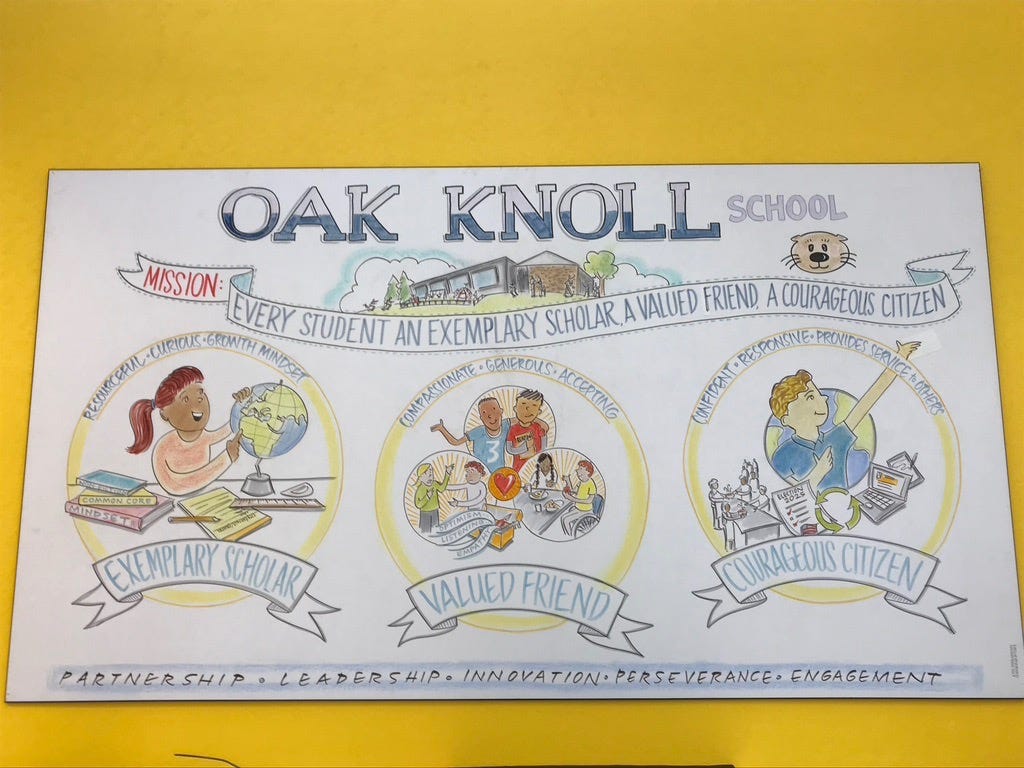
The teachers even began giving out stickers of the core values when they saw a student modeling behaviors of being an Exemplary Scholar, Valued Friend, or Courageous Citizen. When we checked back in with the administration, they reported that the culture had been transformed. Every teacher and every student (including their youngest kindergartners) could talk about what the school valued and cared about!
2. Any Problem Can Be Solved with Simple Pictures
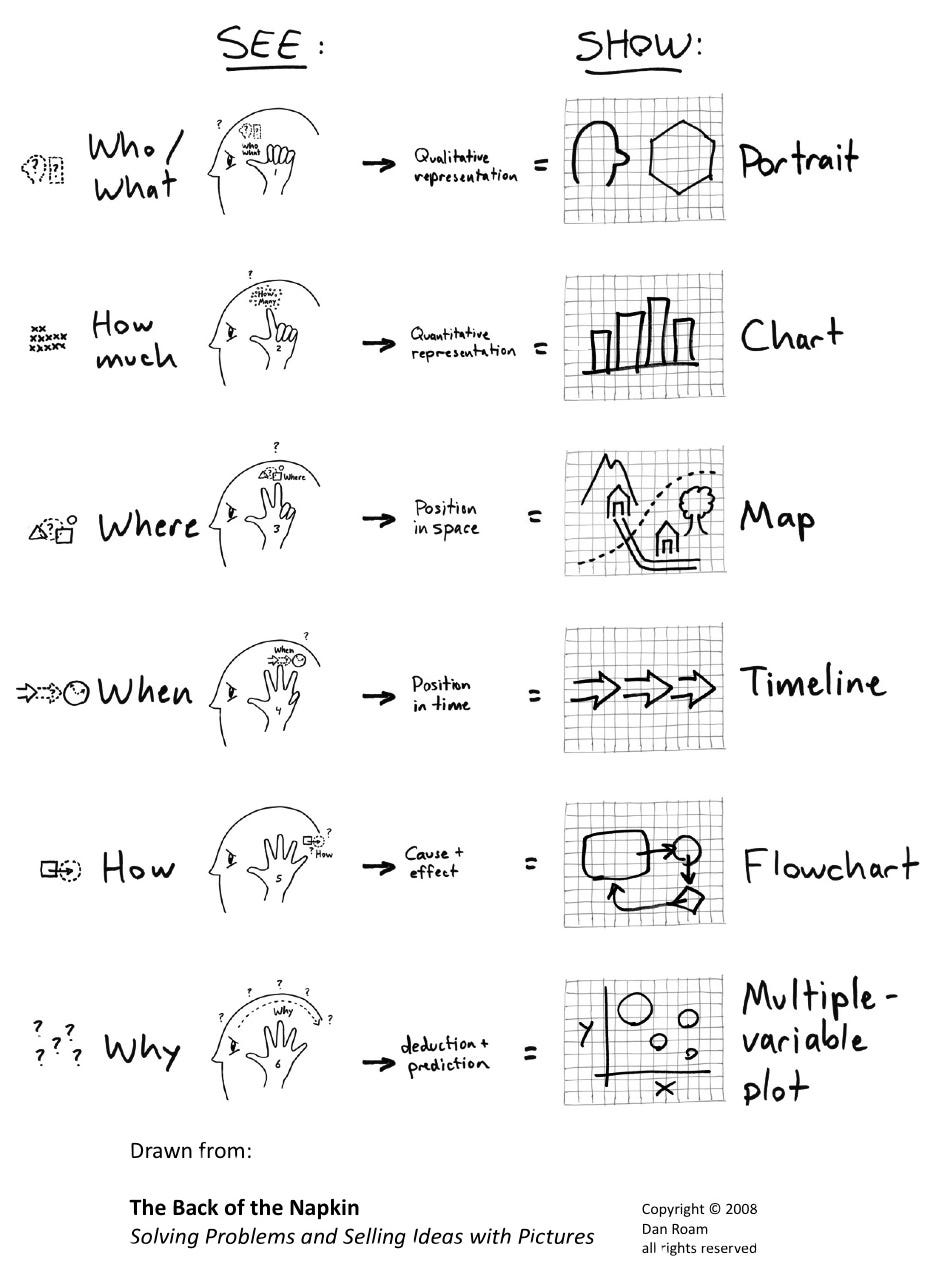
One of the first things I learned from Dan was how to leverage the six visual pathways our brains use to process information. When a problem feels “too big,” our visual system knows how to break it down.
Once you identify which type of problem you’re trying to solve, you can start to draw the solution:
Who/What problems? Draw simple icons or portraits
How many problems? Sketch a basic chart
Where problems? Make a simple map (even just circles on a page)
When problems? Draw a timeline
How problems? Create a flow chart with arrows
Why problems? Draw a simple visual equation
One of the things I admire most about Dan is that he doesn’t just teach visual thinking; he models it. He is a master at deconstructing our most complicated challenges into simple, actionable pictures.
And we’re not talking fancy drawings - we’re talking stick figures and basic shapes of circles, triangles and arrows …. I’ve seen him do this time and time again.
His online Napkin Academy and books are filled with living case students of work and impact. During our conversation we talked about the incredible story of how he once simplified a 1,300-page legislative bill into 33 simple sketches that became one of the most downloaded presentations in history and led to an invitation to the U.S. Capitol!
3. The Person Who Picks Up the Pen Solves the Problem
Dan and I spent a lot of time talking about the rise of AI and the impact it may have on our critical thinking skills.
While AI can generate stunning images, Dan is adamant: “The story is yours. You have to tell it.” When you pick up the pen, three things happen:
You clarify your own thinking (you can’t draw what you don’t understand).
You create a shared reality (literally getting everyone on the same page).
You claim agency in a moment that feels overwhelming.
In our conversation, Dan reveals his perspective about the role of AI in visual storytelling and creative problem-solving, and potential implications for the creative community.
As he shares “Do not offload your ideas to the robot. The robot doesn’t know your story. The robot doesn’t care about your story. The robot is basically a very, very fancy mad lid in theory, everything I do could be done by generative AI. Just because there is a robot that can draw a picture does not in any way mean that I can’t. It’s about personal agency.”
Why you need to listen to the full episode
We talked about more than drawing. We discussed the ethics of human creativity in an automated world. If you’ve ever felt stuck in a meeting that’s all talk and no action, this episode is your toolkit for changing the room’s energy.
Listen to the full “How We Future” Conversation with Dan Roam here
How We Future: Your Turn
Next time you face a complex problem, don’t just talk about it. Draw it.
Give yourself permission to draw “badly.” Stick figures, circles, and arrows are all you need. Remember, you aren’t creating art; you are creating a better future, one simple picture at a time.
The pen is right there. What are you waiting for?

Lisa, having worked with Dan and in this space for 3 decades I have to say first, BRAVO, this is such a needed, obvious yet underutilized capability.. And I want to do a shout out to some of the early pioneers, The Grove (Bay Area), Celemi (Sweden) and Root Learning (Chicago.) They've all been pionners - mentors - first movers. AND, I have a project in this space I'd love to talk to you about. Will reach out. Julie