

Learn to Communicate with Confidence and Clarity
With Think Fast Talk Smart's Matt Abrahams

Who Doesn’t Want to Think Fast and Talk Smart?
In Season 3 of How We Future, we’re treating each episode like a class we wish we’d been taught.
Tina Seelig kicked us off last week with a masterclass on architecting your own luck (check it out here).
My next guest is Matt Abrahams — Stanford Business School lecturer, author of Think Faster, Talk Smarter, and host of the #1 communication podcast in 120 countries.
The need to communicate well is universal. And not just during formal presentations, but in spontaneous exchanges of small talk, introductions, Q&A and more.
Matt is an expert at breaking down the skills to do so, and he shared some amazing advice in this week’s episode of How We Future.
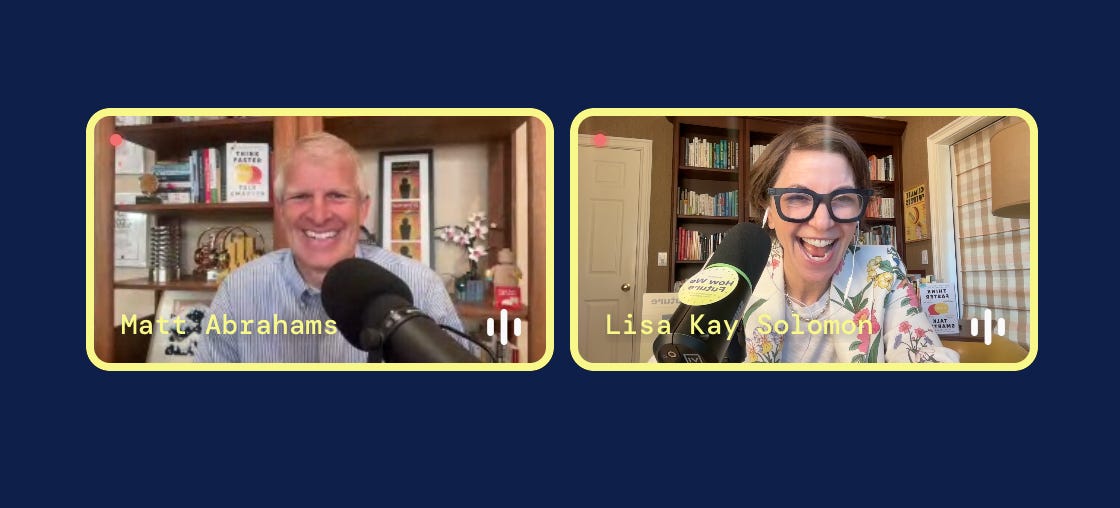
Instructor: Matt Abrahams
Class Exploration: Speaking Up with Confidence and Clarity
Communication seems to come naturally to some people, and, for others, it is their biggest nightmare. The fear of public speaking can produce feelings of anxiety and stress analogous to our greatest fears. It’s so common, there’s actually a name for it. It’s called “Glossophobia.”
Drawing on psychology, neuroscience, anthropology, and improv, Matt has spent years building a methodology that challenges the assumption that public speaking is a natural gift reserved for a special few.
Every incoming Stanford MBA student spends time learning Matt’s methods in their opening weeks of the program. With some structure and practice, students feel more confident. Faculty notice richer conversations. The entire learning experience gets better for everyone.
And, luckily, Matt is committed to sharing his practical toolkit with the rest of us!
What to Listen For
Matt helped me learn that one the most effective ways to communicate about the future is to stay as present as possible.
And staying present while learning from Matt is easy. He’s an extraordinary teacher and communicator himself!
Here are a few to keep in mind as you listen to the conversation:
Anxiety is a sign that we’re human… and that we care.
It’s normal to feel nervous about speaking in public. But you can channel that energy productively. Instead of saying “I’m nervous,” instead think “I’m excited.”
Matt talks about exploring both the symptoms and sources of anxiety so you can turn that energy into something productive. We all get plagued by the internal “Itty bitty shitty committee” that can undermine our confidence (h/t to Denise Brosseau for naming that for me). This is also often a form of “imposture syndrome.” And, as we talked about in last week’s conversation with Tina - we’d be much better off thinking of it as “improvement syndrome.”
Matt talks about how focusing too much on our desired future outcomes, like getting approval or funding or our ideas, often gets in the way of communicating authentically. When we stop trying to perform perfectly and start trying to connect genuinely, something shifts for us and for the people we’re speaking to.
Connection, not perfection, is the real goal.
Spontaneous communication is a skill that can practiced.
We accept that nobody is born knowing how to build a spreadsheet or write a business plan. So why do we expect ourselves to be naturally brilliant at speaking on the spot?
Matt offers a wide range of concrete approaches — from tongue twisters before big meetings, to practicing listening to ease small talk, to using AI to rehearse Q&A — that help us practice the skills we need before we’re in a high stakes situation.
Matt’s advice reminds me of one of my favorite philosophies: better to rehearse the future than be blindsided by the present.
Engagement beats information, every time.
Matt is masterful at creating learnable structures for connecting with an audience at a human level.
Here are a few of my favorite frameworks on how to (re)organize your message:
When presenting: What do you want your audience to know, feel and do?
When pitching an idea: Be sure you can answer “What. So What. Now What?”
When answering a question: ADD (Answer, Detail, Describe the relevance).
The goal of most communication is simply to earn the next conversation or step in the process, not to close the deal all at once. That reframe alone is worth the listen.
“I used to think… and now I think.”
I used to think effective communication was about saying the right thing. And NOW I think it’s about creating the conditions for the right conversation — which is something anyone can learn to do.
There is no “right way” to communicate, but there are ways we can all get more confident and comfortable in our approach.
What’s your “I used to think… and now I think” after listening? Drop it in the comments — I read every one.
Listen to the episode on:
Find out more about the episode and read along:

Follow How We Future:
Want to contact us? Email hello@howwefuture.com