

Thinking in Generations
Roman Krznaric on What We Owe the Future

“Are we being good ancestors?” — Jonas Salk
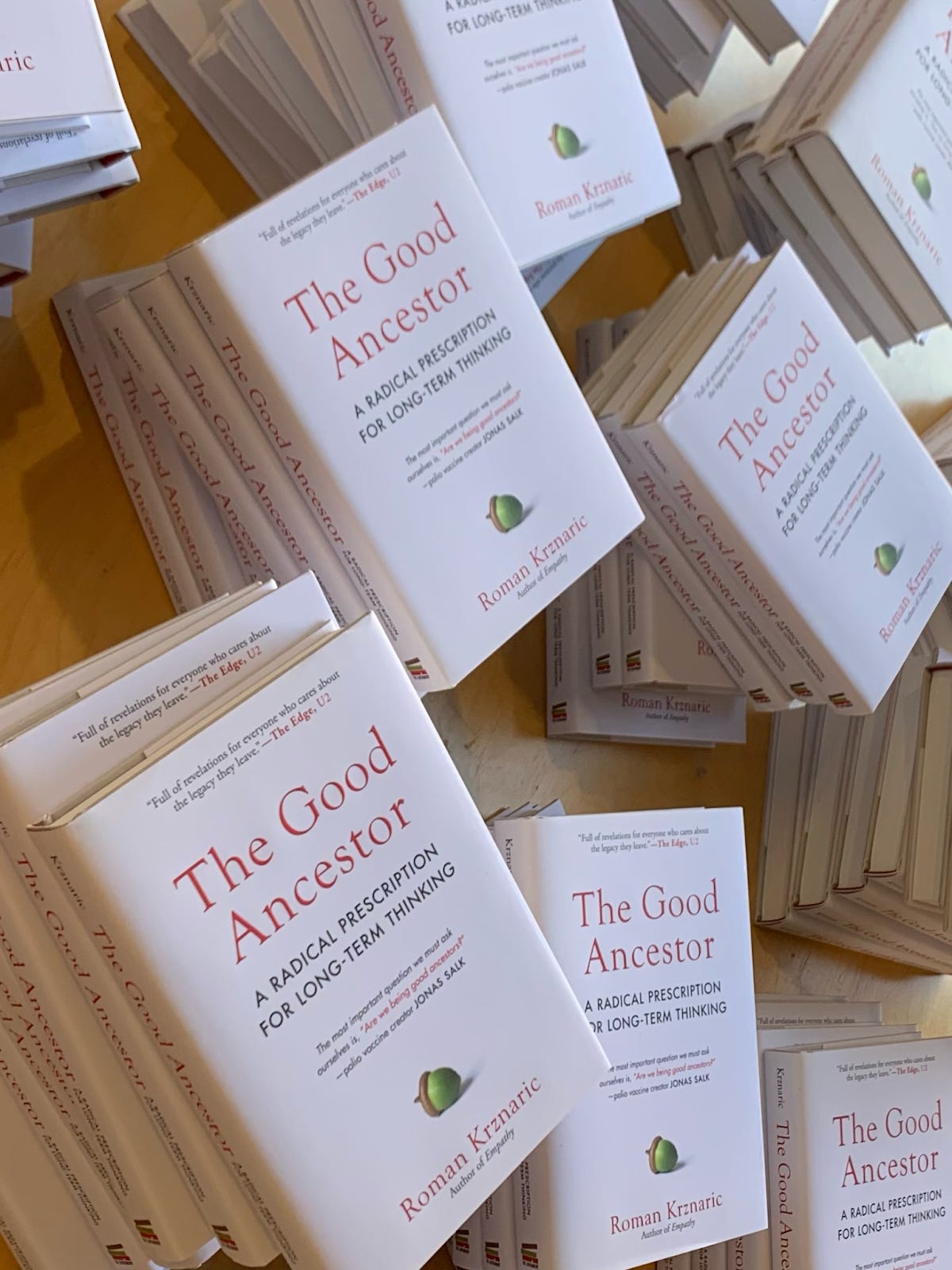
I first encountered this question a few years ago in Roman Krznaric's book The Good Ancestor: A Radical Prescription for Long Term Thinking. I currently live in Silicon Valley, arguably the global epicenter of "move fast and break things" — and this simple provocation created an instant reframe of long-term responsibility and generational care. Not as an abstraction. As a personal reckoning.
I’ve been asking the question ever since. In my classes at the Stanford d.school, in the futures workshops I run with leaders, in my own quiet moments. I wrote about it and shared Roman’s work with as many educators as I could. I even recorded a conversation with Roman about it for school leaders to help them reframe their purpose in the years following the pandemic (listen here).
Roman is one of the most compelling long term futurists that I know. Recently, I had the pleasure of revisiting what it means to be a good ancestor amid these turbulent times with Roman himself on How We Future.
Below are just a few highlights from our conversation, but I strongly encourage you to listen to the full conversation.
1. You Already Have a Long-Term Brain. We Need More Practice Using It.
Roman draws a distinction in what he calls our “marshmallow brain,” the dopamine-driven impulse that reaches for the immediate reward, and our “acorn brain,” which is wired for longer term thinking and decision making.
It can be hard to flex our acorn brain amid “the tyranny of the now.” Algorithms, constant notifications, activities driven by quarterly earnings cycles are all perfectly engineered to feed ever faster cycles of short term thinking. And then we wonder why the future feels so frantic and frenetic.
But that’s what makes it even more critical to recognize and fuel our neuroanatomy capable of planting something we’ll never see fully bloom. It’s what’s helped imagine and build the Sagrada Família (begun in 1882, nearly complete 150 years later). The London sewers, designed twice as large as needed, still in use today. The 10,000-year clock being built by The Long Now Foundation, with which Roman and I are both affiliated.
“We keep telling ourselves we’re short-term thinkers. But that’s not the whole story of who we are.” — Roman Krznaric
We are all wired for both. The question is which brain we’re practicing.
With so much distracting us, it can be hard to protect time for long term thinking. It can feel indulgent to take time away from answering emails and attending standing meetings, and yet, that may be exactly what we need to get beyond spliced attention spans and reactive responses.
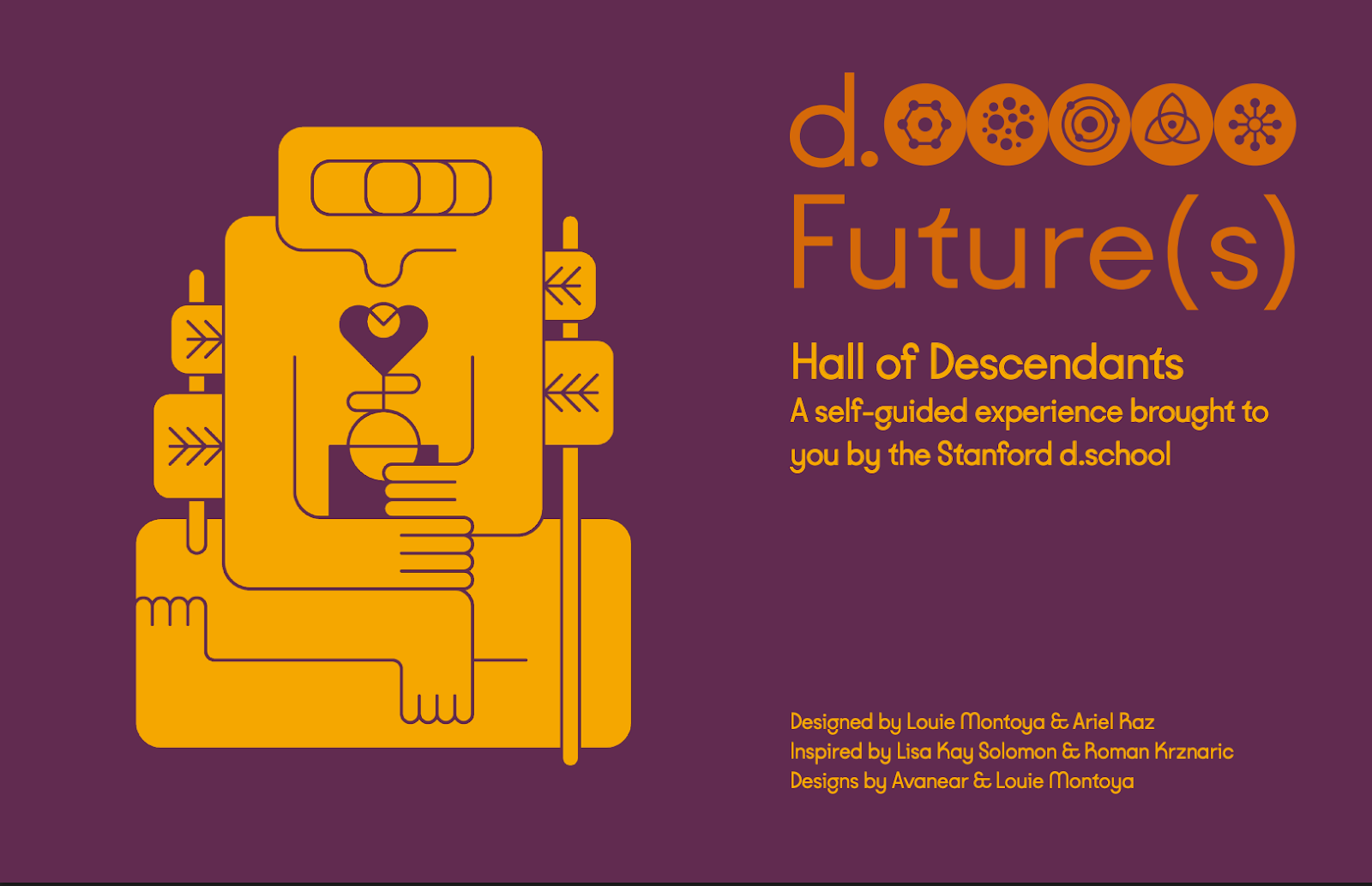
At the d.school, my brilliant colleague Louie Montoya built a workshop inspired by Roman’s work called the Portrait of a Descendant. Participants imagine their descendant’s descendant’s descendant, build a physical portrait of them, and write them a letter. We’ve brought it to South by Southwest, the Smithsonian Futures Museum, and classrooms across the country. Every single time, the room shifts. The future becomes intimate and concrete.
2. History As a Futures Tool
Roman’s newest book, History for Tomorrow: Inspiration from the Past for the Future of Humanity makes a case that looking backwards can give us important clues on how to shape what’s to come. It’s focused on compelling bright spots of social, cultural, technical and political breakthroughs; moments when human societies innovated within limits and built something that lasted.
His favorite example is 18th-century Edo (today’s Tokyo). Edo operated what we’d now call a circular economy out of pure necessity. A kimono became pajamas, then diapers, then cleaning cloths, then fuel. Scarcity drove creativity. As Roman puts it: “Mozart composed on a five-octave piano. Jimi Hendrix played a six-string guitar. Constraints are an invitation to imagination, not the enemy of it.”
By examining these histories, Roman is hoping to expand the surface area of possible futures.
I’m a big believer of leveraging ‘bright spots’ as a way of reimagining beyond the status quo. When we have an example of something that has worked, even in a small way, it breaks through the “that would never happen” assumption.
In 2024, I architected a multi-faceted gathering at the d.school called “The Futures Happening” to foster civic imagination and stronger democratic futures that was entirely designed around celebrating, sharing and amplifying working experiments across geographies, generations, and cultural touchpoints. See here for our bright spot library of diverse “Democracy Makers,” and here for our Futures Happening Playbook focused on helping others find and celebrate bright spots in their communities.
3. The “Disruption Nexus”: Crisis, Ideas, and Disruption
One of the most useful frameworks in History for Tomorrow is the disruption nexus: transformative change happens when a crisis, new ideas, and disruptive movements converge at the same moment. Think the fall of the Berlin Wall or the civil rights movement.
As a futurist, I am particularly drawn to his focus on the need for new ideas to be present in the framework. Reaction alone isn’t enough. Protest alone isn’t enough.
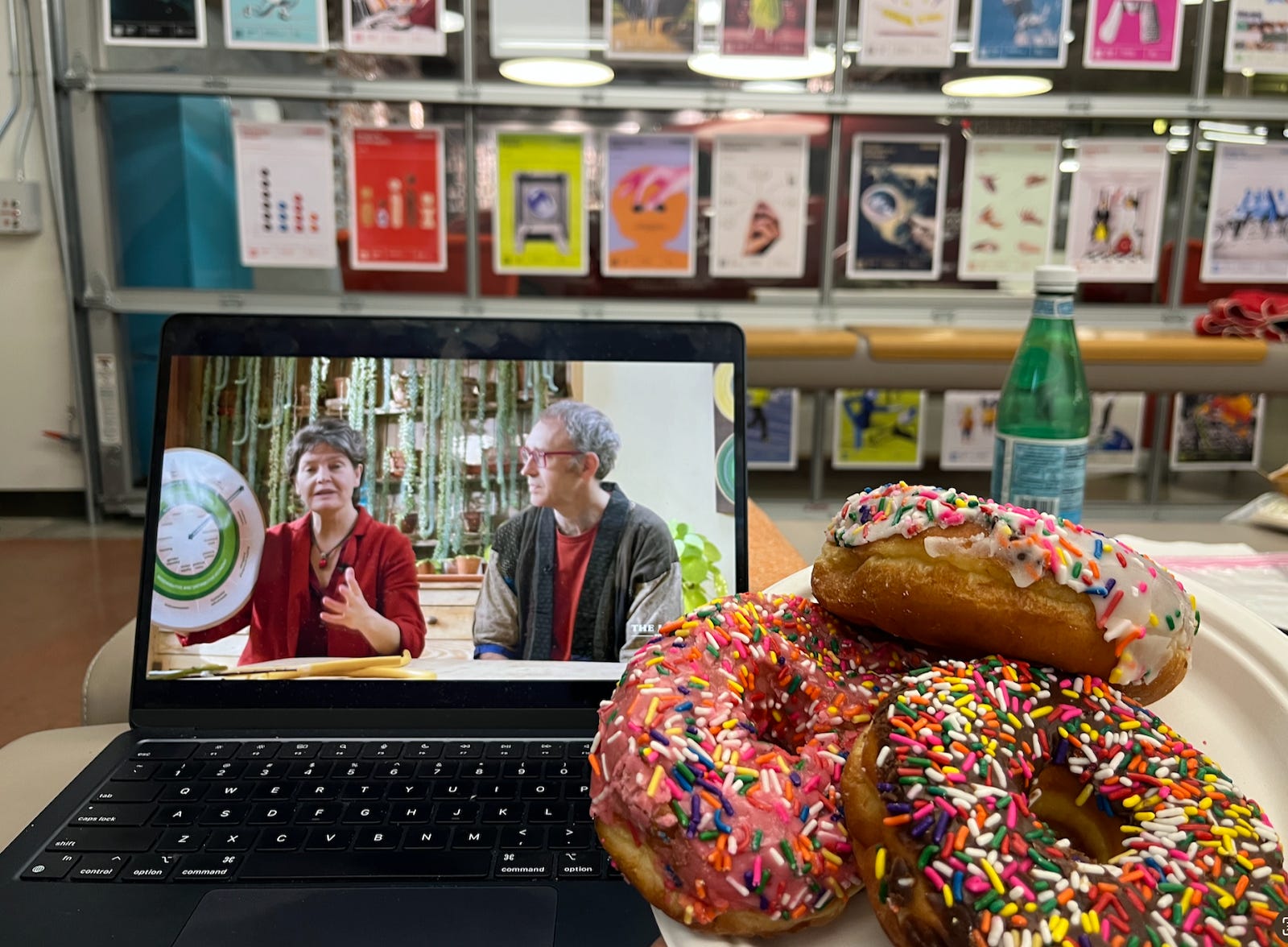
We need new and novel frameworks and narratives that give people something to move toward in generative and productive ways. For example, Roman’s partner Kate Raworth’s invention of “donut economics,” which provides a new non-exploitative model for sustainable development that balances human needs with planetary boundaries. There is a growing global community of Donut Economic Action Labs (DEAL) around the world, transforming emerging research, prototypes and new experiments into transformational action.
Among Roman’s many great TEDx talks worth watching, one of my favorites is a compelling conversation between him and Kate at their kitchen table discussing the intersection of their work for a Long Now talk: “What Donut Economics can Learn from History.” See picture below for the donut watch party I held at the d.school for their talk!
How We Future: Your Turn
As you explore opportunities for you to practice “thinking in generations,” try one of these:
Ask the Salk question: Inside one real decision, ask: Am I being a good ancestor here?
Color-code your calendar: How much time are you actually investing in acorn thinking (planting something for the long term)?
Write a few sentences to your descendant’s descendant: What do you hope they inherit from choices you’re making right now?
The future isn’t science fiction. It’s an intimate family fact, and we’re already building it whether we’re paying attention or not.
