

How to Sit with "Maybe"
With Sabrina Sullivan, Corporate Foresight Practitioner and Researcher

What is futures work, really?
I get asked this a lot.
My next guest, Sabrina Sullivan, is focused on explaining what futures work looks like within organizations in simple, accessible, relatable language.
Sabrina is a corporate foresight practitioner, researcher, and educator who is passionate about integrating futures work into our everyday thinking, planning and acting. Starting at our youngest ages.
We re-crossed paths at the 2025 Dubai Futures Forum last November, which was an awe-inspiring event of more than 2,500 futures practitioners from around the world.
Not surprisingly, it felt like Sabrina knew all of them. She’s as prolific in making generous connections as she is in advancing the field.
Keep reading and listen to the episode to learn how futurism can be incredibly valuable in organizations, classrooms, and even your home.
Class Exploration: Futures Spectrum: the wide range of ways we future
Instructor: Sabrina Sullivan
What to Listen For
Sabrina is one of those rare people who can make the abstract feel completely actionable. Here are three things to keep in mind as you listen:
There are many roles in Futures Work.
Sabrina has been researching what foresight practitioners around the world actually do by surveying nearly 100 people across 30+ countries.
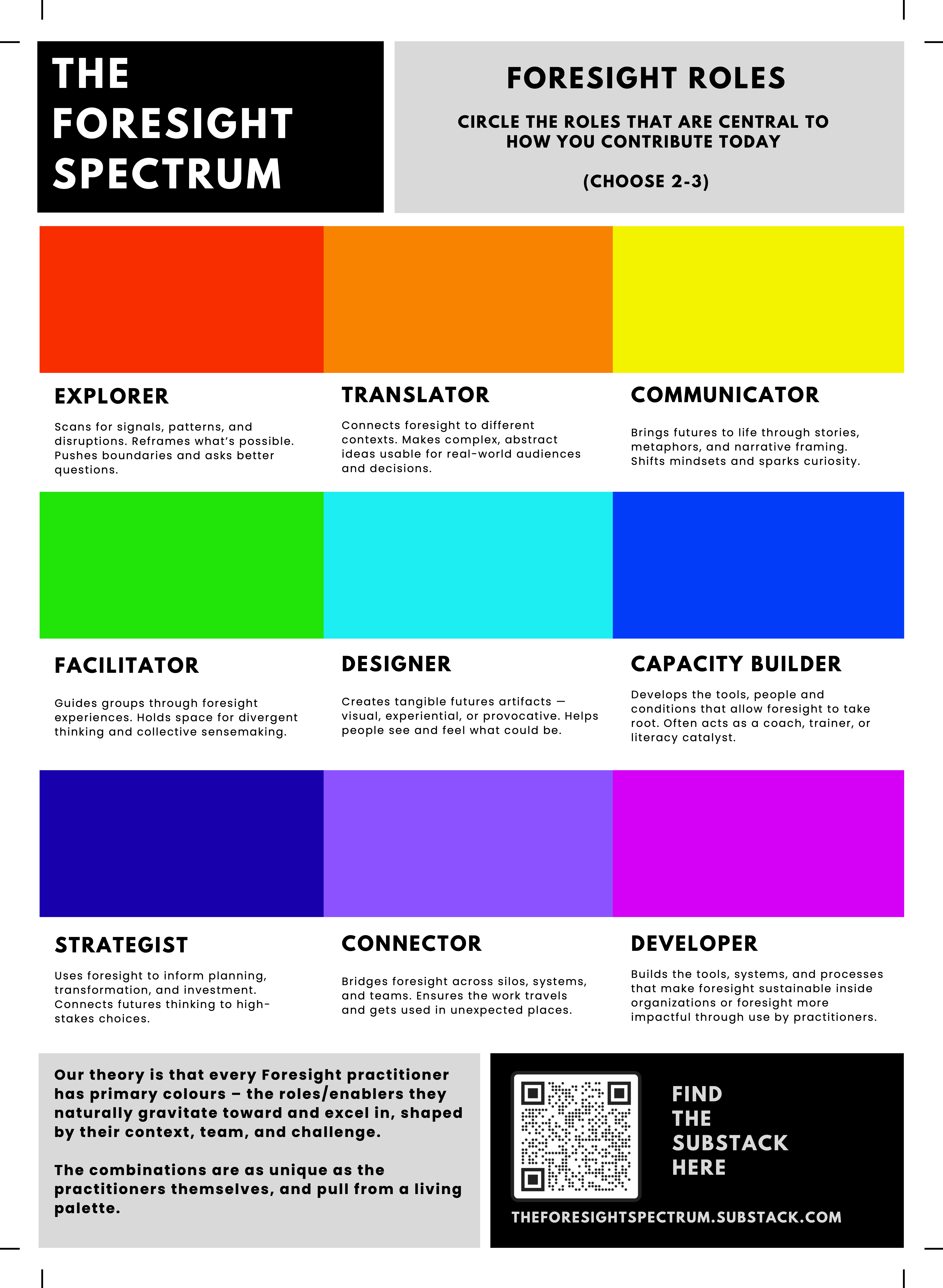
Working with fellow futurist Deborah Hayek, she’s used that insight to create the Futures Spectrum, a descriptive articulation of the various ways futures practitioners add value to inform strategy, innovation, learning and culture.
Sabrina and Deborah identified eight distinct roles across three areas: making sense of signals, building others’ capacity to think about the future, and connecting insights to real decisions and action. See visual below.
As someone who has worked in this field for nearly 25 years, and still struggles to answer the question, “so what do you actually do as a futurist?,” this mapping is a true gift.
Futures work requires emotional care
Sabrina and I discuss an often overlooked element of futures work - the emotional toll it can take.
When done well, futures work can expand our range of possible, which can include both positive futures and ones we’d like to avoid.
It can also disrupt long held assumptions we believed to be true. You may leave a session thinking: I’ve been operating on assumptions I didn’t even know I had.
The most important thing a foresight practitioner can do is simply create the space and psychological safety for people to stand in the future with curiosity instead of dread.
And, importantly, to give proper time for reflection. As Sabrina puts it plainly: “It doesn’t happen in a half hour.”
Make friends with the “Maybe Monster”
Among her many projects, Sabrina has been writing a children’s book called The Maybe Monster — built on the insight that our relationship with uncertainty is often fear-based, socialized at young ages.
But if we learn that the “monster” around uncertainty isn’t something to run from, but rather something to call in, we can build comfort and capability with ambiguity from a very early age.
She recently ran a “Futures Passport” pilot with her daughter’s third-grade class — a week of daily activities that culminated in a Future Helper Hiring Fair.
Kids pitched solutions to problems they genuinely cared about: space debris, ocean cleanup, alternative ways to take medicine. They also interviewed their parents about technologies they once thought were unimaginable.
This resulted in intergenerational conversations around the kitchen table about the future. Eight and nine year olds asking: What’s good about this future? What’s tricky? And how do we make sure it’s kind and fair?
Sabrina is in talks with publishers now. Stay tuned for the Maybe Monster!


I used to think… and NOW I think
After talking with Sabrina, my own reflection is this:
I used to think “maybe” was a frustrating non-answer. And NOW I think it might be one of the most powerful words we have — if we learn to work with it instead of rush past it.
We can’t expect people to be skilled at things they’ve never practiced.
Getting more comfortable with uncertainty requires that we invite the “Maybe Monster” to the conversation.
Listen to the episode on:
Find out more about the episode and read along:

Follow How We Future:
Want to contact us? Email hello@howwefuture.com