

Assembling Tomorrow in a NUTS World
With Stanford d.school's Scott Doorley and Carissa Carter

In the movie My Big Fat Greek Wedding, there’s a fabulous scene where the proud Greek father says: “Give me any word in the English language — and I mean any word — and I’ll tell you about its Greek origin.”
This is exactly how I feel about design. Give me any problem — and I mean any problem — and I’ll tell you why it’s really a design problem (or design opportunity!).
Design is everywhere. And we’re all designers.
And yet very few of us have actually been taught how to think about design as a set of practices, postures, and processes for solving problems and shaping futures.
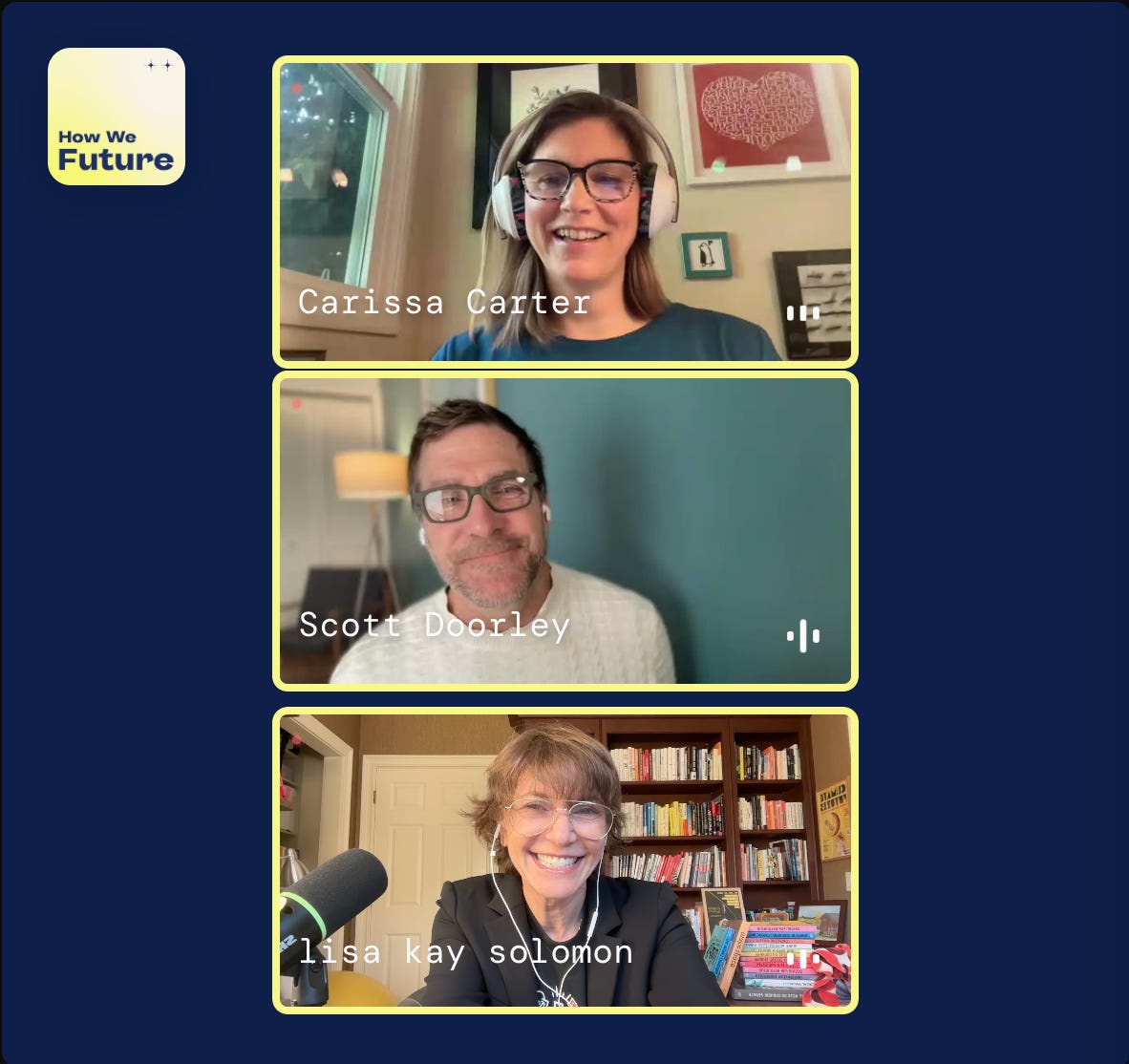
It feels fitting, then, that my final guests for Season 3 of How We Future are two of my design inspirations: Carissa Carter and Scott Doorley.
Carissa is the Academic Director of the Stanford d.school, overseeing the full suite of classes we teach. She authored the wonderful book The Secret Language of Maps about data literacy and data visualization (see here for an earlier Q&A I did with her about the book), and has crafted more frameworks and innovations to spread the widespread use of design than I can count. We talk about a bunch of them in our conversation, including her award-winning “I Love Algorithms” project.
Scott is the Creative Director of the d.school and has been teaching and shaping it from its earliest days nearly 20 years ago. He oversees our brand and creative mission and has spearheaded some of our most strategic initiatives — including overseeing the recent publication of 12 d.school books, Stanford Project 2025 on the future of higher ed (produced in 2014!), our recent 20th anniversary celebration of the d.school highlighting David Kelley’s Creative Essentials. Scott is one of the pioneers of open space collaboration and co-authored the fabulous book Make Space (with Scott Witthoft).
These two superb designers — and close colleagues and treasured friends — co-authored a powerful book called Assembling Tomorrow: A Guide to Designing a Thriving Future a couple of years ago, articulating how we can all harness the power and possibility of design to become more responsible, compassionate, and caring stewards of our communities.
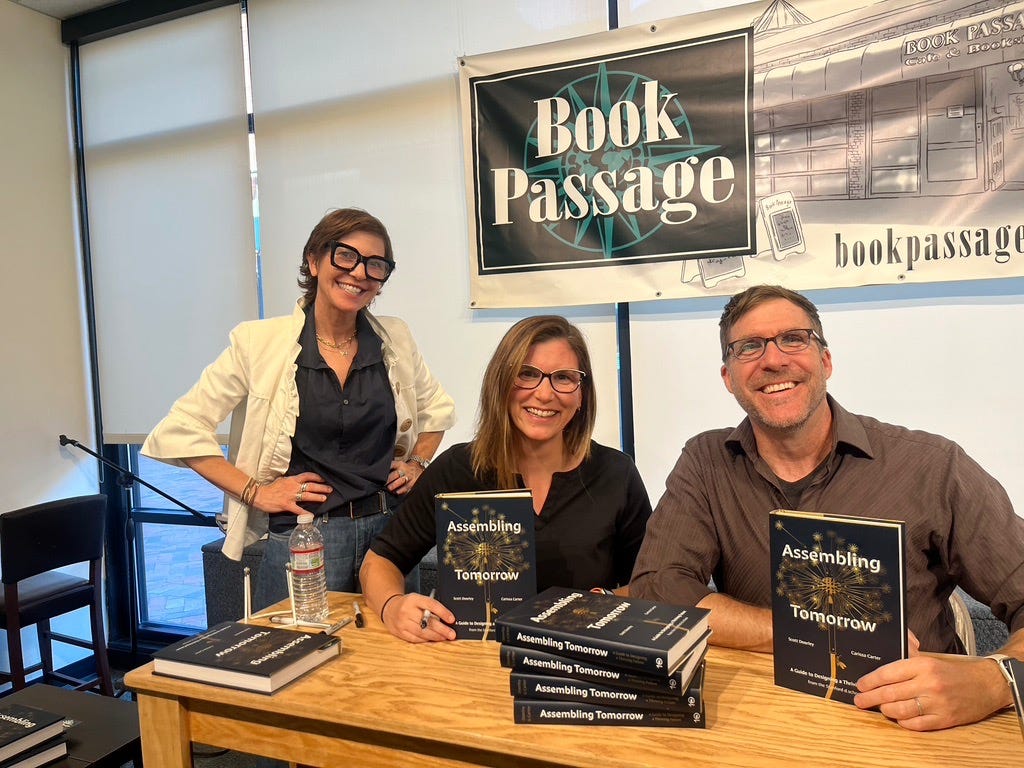
Here are just a few gems from our conversation.
The world feels NUTS (Never Up to Speed). Design practices can help.
One of the core theses of Assembling Tomorrow is the concept of “Runaway Design.”
Like a runaway train, the code — and what code can do — is getting away from us. In algorithms, synthetic biology, robotics, drones, living materials, and more. Carissa and Scott named this dynamic years before ChatGPT came on the scene and made the phenomenon more visible.
Scott describes how hard it is to feel clarity and grounding when it feels like we're Never Up to Speed — or NUTS. As they state in the book: "Our nervous systems are nervous."
And none of us make our best decisions in a chronic state of heightened alert. Scott points out how few of us have ever actually been taught how to manage change at all — let alone change that’s barreling at us from every direction.
What we need is Change Literacy as much as Tech Literacy — which includes getting more comfortable with “bothness”: the recognition that rarely is anything purely good or purely bad. Reality tends to live in the middle.
As Scott says: “People tend to create these two camps — anti or pro. That’s never how anything plays out. It’s always somewhere in the middle. And I think we just got to live in the middle and work it out... it starts by just admitting that there’s a middle.”
Design abilities have become more essential than ever.
About ten years ago, the d.school started shifting its focus from teaching “the design process” to teaching eight core design abilities — navigating ambiguity, learning from others, synthesizing information, experimenting rapidly, moving between abstract and concrete, crafting intentionally, communicating deliberately, and designing your design work.
What I find most compelling about this reframe of design into learnable abilities is how applicable they are to all of us in whatever field we’re in. They can help us be more creative and resilient problem solvers, even amid constant change.
For example, “learning from others” can inform new perspectives about people and contexts, “synthesizing information” is critical for sensemaking and pattern recognition above the noise, “communicating deliberately” helps us engage others in meaningful ways.
As Carissa pointedly noted, navigating ambiguity may be more important now than ever — particularly as AI risks eroding our tolerance for not-knowing. “When the crutch of AI gets taken away,” she observes, “people give up far more easily. That's something worth paying attention to.”
"Histories of the Future" through speculative fiction allow us to prototype what's coming.
Throughout Assembling Tomorrow are 20 short science fiction stories. They act as portals to potential future worlds, challenging us to reflect on our values, strategic choices, and the longer-term implications of trends unfolding today.
As Carissa and Scott write in the book: “All designs begin as fictions. As odd as it may seem, make-believe is how things come to be. Both past deeds and future dreams inspire people in the present.”
It is so striking how quickly these stories have aged into the present.
Stories about AI-assisted dating and about siblings arguing over which version of their deceased mother’s AI personality to keep — both written years ago as speculative fiction — have already become reality.
“If you’re not anticipating what’s coming, you’re barely keeping up with the present.”
I also talk about the power of speculative fiction in my previous How We Future episode with The Center of Science and the Imagination’s Ruth Wiley and Ed Finn. It’s a great episode, give it a listen.
One of my biggest takeaways from this conversation and from Assembling Tomorrow is the optimistic power of design to heal.
Carissa and Scott write: “We are living in the history of the future right now. At times, it may feel like things are on the verge of flying apart. But every one of us can put together a flourishing future from today’s parts and pieces. The next seventy years are ours to shape.”
So let’s go shape it.
Thanks for joining Season 3 of How We Future. It’s been quite a journey, and I’d love to hear from you. Which episodes resonated most? Which ones did you share with others? What would you like to see more - or less - of?
And a personal note of hope, hype and gratitude: there’s simply no way I could do this without our extraordinary creative visionaries Franzi Sessler and Janina Engel, and my incredible producer Kaela Rosenbaum — whose own design abilities to navigate ambiguity, craft intentionally, and move between abstract and concrete make this whole experience a true joy.
#HowWeFuture
Listen to the episode on:
Find out more about the episode and read along:

Follow How We Future:
Want to contact us? Email hello@howwefuture.com